
SEO… it’s a bit of a buzzword, isn’t it?
Adverts out there are prompting business owners to ‘get SEO’ or tick SEO off their to-do list.
And that annoys me.
Because SEO isn’t a tick-box activity. It’s also not about tricks and ‘hacks’ that will get your content to the top of the rankings in Google. Those ‘tricks’ could even get your content labelled as spam.
SEO is so much more than any of that.
I’m not going to get too technical and long-winded here but I will give clear guidance on how simple yet effective SEO practices can help your business.
Let’s kick off with a good old definition.
What exactly is SEO?
SEO stands for search engine optimisation. The search engine is usually Google (sorry Bing) and optimisation means that your content is the best quality possible.
It is a process in which tools and techniques are used to drive traffic towards your website, blog, article and other digital content.
Here are some of the key steps that we’ll explore.
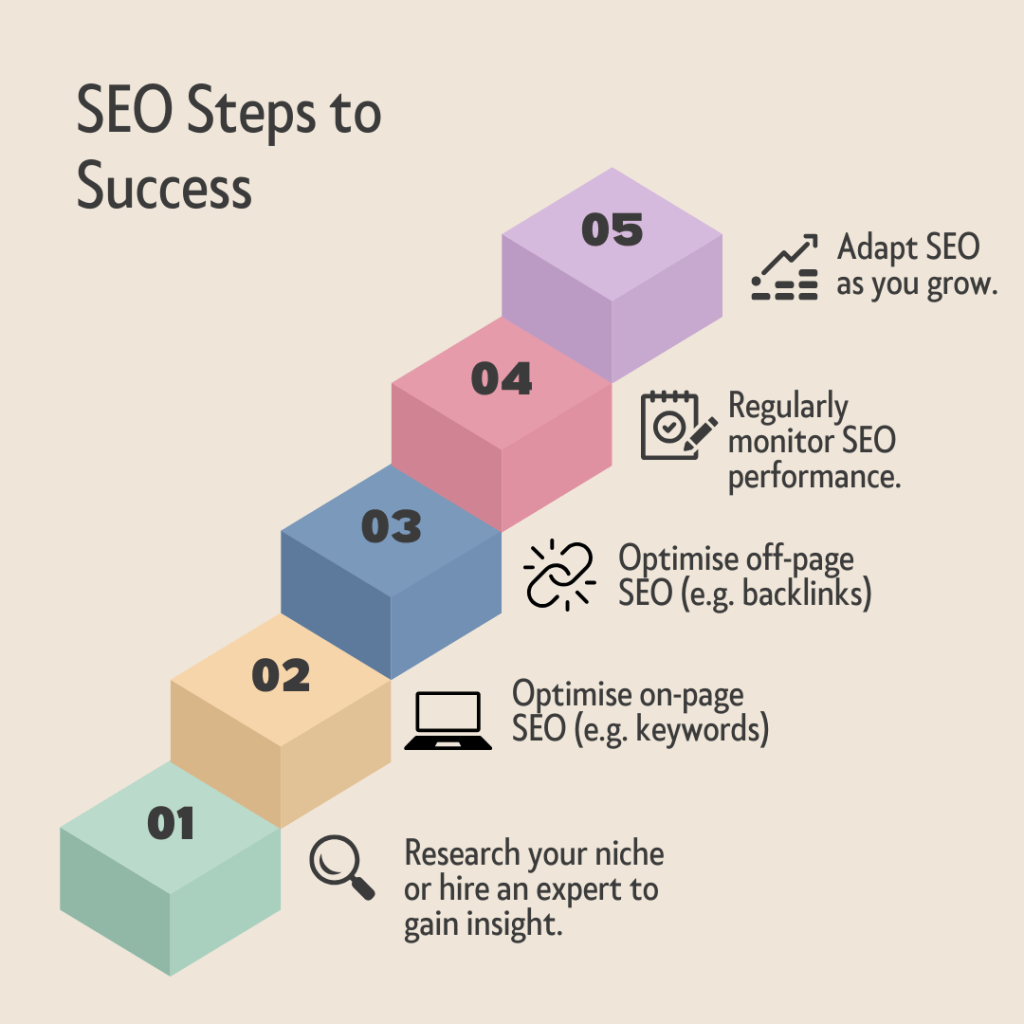
On-page SEO
Optimising content on the web. For example, rewriting your Home Page to include highly searched keywords, a concise structure and helpful information for viewers.
Off-page SEO
Collaborating with external sources to drive customers to your web content. For example, another supplier links your web page (this is called backlinking), social media engagement and online directories.
In this blog, we’ll mainly deal with on-page SEO as that’s the most important starting point for any business and will catalyse growth.
Why is SEO so important?
SEO is a cost-effective way to optimise your content and, if done well, could generate as much traffic to your site as a paid advert.
What else can businesses gain by implementing SEO in their web content?
🤩Attracts more customers
Around 68% of all online experiences begin with a search. If your content (website, blog, article, e-book…) appears on the first search page, you will get more visitors! If it’s easy to discover, customers will choose that convenience any day.
❤️Builds trust in your brand
If potential customers see your content more when they search for what they need, they will soon begin to recognise your brand. Coupled with some valuable information, they will begin to trust your brand as a voice of authority and will be more likely to think of you to solve their problems – plus refer you to others to solve theirs.
🏅Competitive edge
It’s a busy business world out there. You’re one of many businesses (even in your local area) that provide a similar service or product. SEO helps to capitalise on your unique selling point, which sets you apart from your competitors.
📈Increases conversion rates
High-quality SEO educates your potential customers about your product/service quickly. With that understanding, they can make a decision there and then on your website rather than going off to research some more.
How does SEO work?
SEO works on organic searches, not paid advertisements.
For example, organic traffic includes people who have asked Google a question and clicked on your website/social media pages. They might read your content, click on links or share your content and many go on to buy from you.
SEO attracts customers who are further along in their buyer journey – see last week’s blog on the buyer journey for more context. This means that they are genuinely interested in what you have to offer.
SEO offers a measurable impact of your business success as you can track the number of page visits, clicks and, of course, enquiries or purchases. You can use tools like Google Analytics and Google Search Console to help break down the facts and figures.

SEO myth busting
SEO isn’t a tick-box and it’s also not a mysterious magical formula that some people ‘get’ and others don’t.
⌚SEO takes time
It takes time to research, write, edit and publish fantastic content. It also takes time to see the impact so don’t feel disheartened when your sales don’t go through the roof overnight. Growth will gradually increase but you should make sure to nurture that continuously with regular website updates in response to your customer feedback, changing trends and your business goals.
😵SEO isn’t stuffing content with keywords
Using keywords (as we’ll explore in the next section) is a critical element of SEO. But when you get carried away and try to shoehorn them in, the content loses its sense and purpose. Keyword stuffing results in low-ranked content because…no one wants to read it!
⛔A guaranteed No.1 ranking is a lie
If anyone tells you that they can guarantee your website will be ranked first on Google… they’re either lying or potentially using dodgy tactics. Google only know the exact specifics of what will rank the highest and sometimes it’s quite surprising content! Plus, it changes frequently based on the climate, news etc. Being on the first page is a much more achievable aim.
SEO techniques for high impact
You won’t find lots of technical details about code etc here. I recognise that most small businesses are a solo venture and most business owners don’t have the time or brainpower left at the end of the day to learn techy stuff. I know I don’t always!

These are the top, easy to implement SEO techniques that will improve your traffic and sale conversions.
Admin
Bit of a boring start, right? But we all know that boring works – like having an organised filing system so you can find documents easily…

What admin improves SEO?
🏃Improve page speed
This is a big factor in rankings. If your page takes ages to load, it won’t be deemed as readable and accessible by Google.
You can check your page speed here and Google will give you some suggestions for how to decrease the loading time.
🔗Check links
Regularly check that your links are working and pointing to the pages you want them to. If they’re showing error 404 or such like, your website won’t be ranked as highly as it’s lost some of its value.
♊Avoid duplication
It’s best not to copy and paste chunks of the exact text on multiple pages and check that you’ve not accidentally added duplicate product/service descriptions. Duplication can come across as a bit spammy so that’s probably why it’s not seen as a good ranking factor by Google.
Content

In my opinion, the most important technique.
High-quality content has been confirmed as a top ranking factor by Google through it’s EEAT guidelines. Full details of these recommendations can be found here, but here’s a summary of the main features of excellent content.
Quality
💡Your content provides original information, is comprehensive and interesting.
💡Your content is well laid out with a descriptive heading that isn’t ‘clickbait’ and follows through on its promises.
💡Your content is grammatically accurate.
💡Your content provides value and is produced with care and attention to detail.
Expertise
🎓Your content is presented in a trustworthy way with evidence and information about the author
🎓Your content doesn’t have any factual errors.
🎓Your content is well-researched and written by someone who knows the topic well. Research could be into your particular industry to create an informative blog. Or it could be customer research to create truly people-centred products/services.
People-first
🙋Your content is created to help people, not ‘win’ on search engine rankings (just like we said before, no. 1 isn’t important).
🙋Your content shows first-hand experience that you can offer to others.
🙋Your content makes people feel satisfied and like they’ve found a solution/learnt something.
Finding out what your ideal customers’ search intent is can help you write the best web content.
For example, they may search for ‘best eco-friendly deodorants’. Their intent is to compare and at a later date, make a decision to buy. If you have a comparison article on your site (featuring your own deodorant of course), you’ve done half the work for them.
Keywords

Some words are used more in searches than others – it’s a fact! And some of those keywords will surprise you.
If you own a catering company, for example, you might think that ‘party catering’ is a good keyword to include on your website.
Not entirely wrong, however, this keyword has a high search volume of 1600 in the UK per month at the time of writing. It’s quite broad and could bring in customers that aren’t actually going to buy your services.
Something like ‘catering delivered’ for example would be more targeted at customers who know exactly what they want, are happy with your unique selling point and are ready to buy.
You can also appeal to your local audience by including local references like place names or local points of interest in your on-page SEO but remember not to narrow down too much.
Software such as Keywords Everywhere and Semrush help you gain insight into your keywords, but you do have to pay to get the full details.
Links

You can include an internal link within your website on every page to continue the reader’s journey through your product/service pages.
Another technique is to ask industry peers or bloggers to link your website on theirs. This is called backlinking. It establishes you as a trusted source and provides a referral at the same time!
Directories

Get your business listed on as many directories as you can to increase awareness! Some examples are:
- Google business
- Bing places for business
- Yell.com
- Yelp.co.uk
- Yahoo business listings
Have a quick search of any local directories or industry-specific organisations that you can join and remember that Facebook is a huge directory to utilise too.
Reviews

How much more people-focused can you get than reviews? Straight from the mouth of angels who are saying all the right things about your business. Ensure they are front and centre of your website – on the first page and other pages to help nudge potential customers in the right direction as they discover your brand.
Mobile optimisation

Most content management systems (CMS) like WordPress, Squarespace and Contentful and other website hosts provide you with a function to view your page as it would look on a phone.
Use it!
You may be horrified by the results with image and text here, there and everywhere. With a few adjustments, your page will look just as good on the screen of a laptop or phone.
Image SEO

Make sure that images are an appropriate size for your page.
Click on your images and add ‘alt text’. Use the same keywords that you did for your content to push your images up the ranking in Google image search too.
Google search console for SEO insights
Feeling more techy?
Here’s a tool that can give you a lot of helpful feedback.
I’m not a numbers person myself (words all the way) but it is important to gather some metrics on how your website SEO is performing.
Google search console breaks it down into simple visual feedback and provides some steps you can take to improve elements of SEO such as broken links, site speed and unreadable content. It does get quite in-depth in some parts, but you can gain as much or as little from it as you need.
SEO and AI

It’s not a crime to use AI like Chat GPT to help you write your content.
But, I would advise against using purely AI-generated text without your own editing because it can never truly reflect your brand voice in the same way that you or a human copywriter (like me!) can.
You should also be upfront and disclose where AI has been used in your content and why you chose to use it to maintain a relationship of trust in you as a brand.
AI is becoming increasingly proficient at picking up on search nuances and sentiment, which is great! It helps users find what they’re looking for quickly and easily.
With access to such quick answers, it’s never been more important to utilise SEO in your content and ensure your writing is carefully targeted at your ideal customer.

Phew! I hope that’s made SEO seem a bit more manageable.
If you’re a solotrepenuer, remember to utilise those high-impact SEO techniques for results and don’t worry too much about the rest!

Thank you so much for reading.
Next week I’m going to be wanted by the police… the grammar police that is! My mission – debunk the system and break the rules. See you there!
 Hayley Hickmott-Maurice | Copywriting Services