
What does the phrase ‘creative writing’ make you think of?
Maybe you think of a fantasy novel with dragons or a beautifully described countryside scene.

Probably because that’s what we’re taught at school. But it doesn’t have to be magically-charged. So, what is creative writing?
Creative writing is any imaginative or inventive writing.
And what are you constantly doing in your business? Imagining and inventing new solutions to your customers’ problems. Everything starts as an idea, therefore everything is creative at its core.
Now we’ve established that you are a creative in your everyday business (whether you like it or not), let’s dig into some specifics.
Here’s where creative writing can be useful in your business.
Where can I use creative writing in my business?
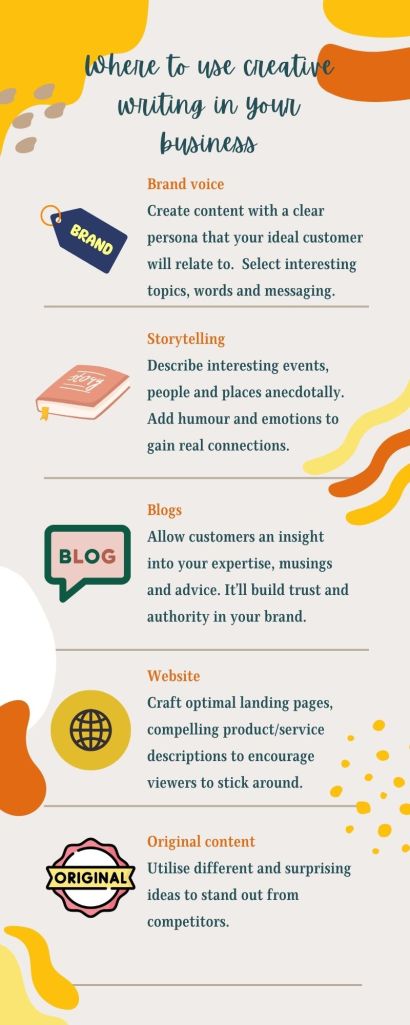
Brand voice
Your brand voice is not going to be exactly how you’d speak to your friends and family. But it’s not going to be stuffy and dry either – even if you’re a formal, professional organisation.
Instead, your voice will be shaped to resonate with your ideal customers. This is where creativity comes in.
Consider who your ideal customer is. A mum, teacher, accountant, public sector worker, landlord, couple…? What words and tone would they relate to the most? You could even plan a mood board or mind map of your brand’s personality and messaging to attract customers who are likely to buy.
This creative process should result in some key words and phrases to use in your content.
Storytelling
I’m not going to encourage you to write your life story and display it on your website’s homepage…
But little anecdotes here and there in your content are a welcome relief to readers. They don’t want to read line after line of ‘salesy stuff’ or heavy information.
Stories don’t have to be long, either. They can be a few lines. For example you might describe a few interesting parts of an event you went to at the weekend. Or, maybe a person you met that gave you some insight. If your story calls for some light humour, even better. The more emotionally connected your customers are, the more likely they are to buy from you.
Remember, you don’t have to share super personal information about your health, family etc. Readers are just looking for some light relief and a little chuckle when they scroll – just like you do.
Original content
What content do you remember best? Probably posts or adverts that are a bit different, right?
It’s worth taking the time to create some stand-out content at least every couple of weeks. By this, I mean content that doesn’t follow a set rule.
You may have got into a habit of posting a review in a certain format, for instance. Over time, your audience becomes apathetic to it as it looks so similar to the rest.
Think about changing it up. Could you write more/less? Could you use questions, polls or more images? How about picking some different words or using shorter sentences?
This technique not only grabs the attention of your customers and stands out from your competition, it also gives you an opportunity to see what content really connects with your customers and what converts the most.
Blogs
Blogs have endless opportunities for creativity. You may be blogging about your personal growth for example any training or learning opportunities and reflections on that. Here you can inject your personality and reach out to the audience with questions and opinions.
You may have a blog for ‘How-to’ guides, where you add asides and tips to make your content unique from others on the internet.
Or you may be sharing information. Whatever you’re blogging about, you can do it in your own way. While it is sensible to use SEO best practice to attract traffic, this doesn’t need to restrict your style and tone. Isn’t it nice to have that freedom?
Website
Like your blog, your website can take any form you like.
I’m not advising that you publish your personal poetry onto your business website but…it is another avenue for you to be creative. And remember, you can see what works and change it if it doesn’t land. Some of the key areas to be creative on a website are: landing pages, product/service descriptions and your About Me section.
H.H-M copywriting services give you a creativity guarantee. Get in touch today for 100% unique and bespoke marketing for your business.
Barriers to creativity
It’s inevitable that we will all experience some barriers to creativity at times. Here are the main demons…
Fear of failure

If you’re a perfectionist or an over-achiever (hello entrepreneurs👋) you may experience a fear of making mistakes.
This can sometimes be a hangover from childhood where you were *encouraged* to do everything correctly.
Most of us are still learning how to fully accept mistakes and some days will feel easier than others. If you regularly struggle with this, it might be worth investing in some coaching or therapeutic support.
A saying that has helped me with this is ‘Go with the plan, not the feeling.’ It means that, on days when I’m feeling that imposter syndrome BADLY, I write and publish anyway.
Information overload

This is an interesting one. You may think that to be creative you need LOTS of ideas. But too many can water down creativity. Too much information obscures the key, unique point from your readers.
Clarity is key and often that means one key message for each piece of content.
Some people try to challenge information overload by restricting their parameters. For example, limit yourself to only 6 words or have a time limit of 5 minutes. This can lead to some interesting angles that you may not have explored before.
Burnout

You can’t pour from an empty cup.
Burnout literally feels like you’re exhausted and it’s impossible to perform professionally. It can cause higher levels of cortisol in your system which feeds your fight or flight response and keeps you tense, reducing your sleep quality.
It’s a bit of a vicious cycle and certainly not one in which creativity thrives. If your work-life balance is off, look at ways to take more breaks and enjoy other areas to rediscover your creative side again.
Time

Ah, if only there were more than 24 hours in a day… or we all had a Bernard’s Watch (90’s pop culture for the win!).
Creativity does take time so if you’re rushed and busy you might find you’ve got less brain capacity to think of unique ideas.
On days when you do have a bit more time, prioritise some thinking, wondering and exploration to keep your creative energy up.
How to be creative
Guess what?
Creativity isn’t a magical gift that you have or don’t have.
It can be learned and nurtured!

Although it’s tempting to jump on trends to boost eyes on your messages, your ideal customers will notice you for the unique content that you produce. Here are some methods to get the creative juices flowing:

Plan, jot, doodle
Try planning some of your content in a more freeform way. The messier the better. Being free and loose lets unique ideas come forward.
Emotions
Include emotionally charged questions and impact sentences in your business writing and anecdotes. These stand out to readers and tug them towards your brand.


Play with sentences
Short, long, one word or a few. Keep it different and keep your readers on their toes.
Take a break
If inspiration really isn’t coming, take a complete break from the task and come back to it another time.


Change your environment
Go for a quick walk or just move rooms to get a different viewpoint.
Talk out loud
Ideally, to someone, but hey, if you’re alone, there’s no one to judge you! I find my best solutions by offloading my thoughts (usually onto my husband).

2 min exercise
Here’s a creative writing prompt for you…
1. Think of a new product or feature that you’d like to launch.
2. Give it one word e.g. arch.
3. For 60 seconds, write as many words linked to that as possible.
Arch – curve, round, through, under, beneath, above, look up, stare, wonder, view,
Even if they seem strange/random, get them down. You may discover some magic in there that can be used in a great description for your promo.
Ways to grow your creative writing skills
Still feeling stuck?
Been in your business for a while and feel like you’re out of fresh ideas?
Here are some tried and tested ways to develop your creativity.
📙 Reading
Read as often as possible! A good writing practice is to alternate genres. One month read a gener you know and love, the next month choose a genre you’ve never explored before or a topic you don’t know anything about.
✍️ Writing
It doesn’t have to be handwritten, typing counts! Jot down ideas, phrases and words in your notes to save them for later. The more you do this, the more natural it will become and you’ll discover some real creativity.
💬 Talking
Gain different perspectives by meeting new people at networking or functions. Listen to them speak and notice their words, messages and interesting details. Humans are fascinating and conversations can spark new ideas and opinions every day.
🎓 Learning
Consider taking a course in creative writing skills or any other area of interest. Nurturing your hobbies is just as important for creativity as it opens your mind and puts you in a better mood to explore new ideas.
✈️ Travel
There’s just so much to see out there and I love the fact that we can never know everything. But we can pick up interesting details, information and quirks along the way that would give our content a unique angle.
I hope by now you’ve been able to challenge your own view of creativity and realise that you can be creative.
Even better, you have the creative tools you need to grow your business.

Thank you for reading today. It’s been a pleasure!
Come back next week for a deep dive into email writing. It’s going to be a biggie!
Would you like ready-to-go templates and digital content? YES? Complete this survey to let me know what you need, and watch this space for my digital product launch!
 Hayley Hickmott-Maurice | Copywriting Services