
So, your email marketing has been in place for at least six months, maybe even a year. (If you’re not quite there yet, you might want to check out some of my earlier email marketing posts).
You’ve been reviewing the metrics regularly to see which emails perform well and gained some great clients in the process.
But then… PANIC. You review your stats one month and there’s a whole bunch of subscribers who haven’t even opened your email. Next month, the same story.
Why aren’t they engaging anymore? Should you remove them from your list before they unsubscribe themselves or just wait it out?
What can I do if my email subscribers stop engaging?
First off – this is really common. So take a moment and slow those spiralling thoughts down.
It doesn’t mean they don’t like you anymore, and it doesn’t mean that you’re doing something majorly wrong.
Unfortunately, disengagement just happens. Sometimes it’s because the initial excitement of your offers has worn off for the subscriber and sometimes it’s just life getting busy for them.

What can you do?
Enter – the re-engagement email.
What is a re-engagement email?
A re-engagement email is a targeted message sent to inactive subscribers.
It could be a group in your audience that hasn’t opened any links or even a group that hasn’t opened your emails altogether.
The aim of your re-engagement email is to prompt action. Action could take the form of an open, click, social media like or, of course, purchase or booking.
The importance of a re-engagement email
Although these emails are usually very simple and sparse, their importance cannot be understated.
Here are some of the significant benefits:
⬇️Lower churn rate
A churn rate is the rate at which customers stop subscribing. Naturally, you want this to be as low as possible to spread your message to as many potential clients as you can. Also, a lower churn rate makes your mailing service more deliverable.
🔥Rekindle spark
A little bit of science – A compelling re-engagement email can release some serious dopamine1.
If your message is viewed as pleasing by the reader, this dopamine triggers a set of positive emotions. These lovely emotions are then ‘tagged’ in the subscriber’s brain as an association with YOUR brand. The brain cleverly remembers this pleasurable experience and seeks to encounter it again.
Bingo! Your previously unengaged subscriber’s motivation has been rekindled, and the excitement for your brand rediscovered.
🤝Nurture long-lasting relationships
The effort you’ve invested in reaching out personally (more on that later) to your subscribers will not go unnoticed. They will be reminded of your caring nature and the individual attention that you give to the people in your mailing community.
This does more than just re-engage them for one email, it brings them back on board for a longer-term commitment.
📈Gain sales
We’ll see some examples of offers and rewards that can be utilised to not only re-engage customers but also prompt them to make a purchase or booking. But in reality, any technique you choose for your re-engagement email can prompt a sale. With a strong CTA and a personalised approach you can direct them right to your booking page or e-commerce platform.
📢Earn referrals
A disengaged few are no longer seeing your emails. You’ve blurred into the background of their inbox.
In that case, they’re unlikely to remember your brand when a colleague or pal needs a service you provide.
Your re-engagement email will bring you right back into their minds and keep you memorable for those all-important word-of-mouth referrals.
Some convincing benefits, I’m sure you’ll agree. Now we move on to some more practical tips.
What to include in your re-engagement email
Your email will be representative of your brand. Like any content, it’ll speak true to you, with your brand voice and professional persona at the forefront.
Here are some specific features that have been proven time and time again to win subscribers back.
Personalisation
If you’ve ever received an email with your name in the subject line, you know exactly how this feels.
Maybe you’re the type of person who responds with ‘Ahh, it’s for me!’
Or maybe you’re a bit cautious – ‘Why are they using my name?’.
Or maybe you’re even a bit on edge – ‘That’s a bit creepy… using my name.’
It’s a fact that, whatever the response, readers are more likely to open an email that uses their name because it creates an emotional response. In fact, your audience is 26%2 more likely to open an email that is personalised.
Great subject line

A punchy subject line is as important to a re-engagement email as personalisation.
If your subject line doesn’t catch the eye, your disengaged subscribers won’t open that email either.
No pressure!
Luckily, there are some sure-fire ways to create intrigue, urgency and inspire action from your audience.
For example, you can include a clear offer in your subject line, with a countdown e.g. only 12 hours left of our big sale.
You could also use questions to prompt an emotional response.
Whichever line you choose, make sure it’s short and includes a clear prompt to action. Using an emoji has been proven to increase open rates by up to 50% so that will also work in your favour.
Clear, welcoming design

Next, is the visual. Yes… this even comes before the content of the email in this case (shocking coming from a writer, I know). But the human brain makes such quick impressions using images that it’s so important to choose the right ones.
I would advise on a simple approach. One or two images will be enough to convey your message.
Limit any other distractions, e.g. too many colours, links, and banners. You really just want your subscriber to take action so their eyes should be drawn from an image straight to the CTA.
Compelling content

In this case, less is definitely more. One or two lines could be enough! Your subscriber will be scanning the content quickly so get to the point without any waffle. What’s in it for them?
Fulfil the promise you made in the subject line, quickly and efficiently.
For instance, if you promised a reward coupon, your content could read:
‘You’ve been a loyal customer for over a year. Thank you! Here’s your reward coupon – enjoy!’
Strong CTA

Just like the subject line, your call to action button should be strong and directive. Keep it short and reflective of the content so that everything connects and it’s easy for the reader to follow your thinking.
Using the coupon example above, your CTA button could say, ‘Use your coupon!’. It would then take the subscriber to your e-commerce platform, where they’ll see the coupon already loaded into their basket.
Think about timing

When you look at your group of disengaged subscribers, you may notice that a lot of them fall under the same industry or demographic.
It is also worthwhile analysing when most of this group access their emails. Are they lunchtime viewers or late-evening scrollers?
Go with the majority and send your email at their most active time.
You could take it a step further and segment your un-engaged subscribers into time groups if YOU have the time yourself.
Re-engagement email strategy
There are several different tactics that you can use as a sort of theme for your re-engagement message. The approach you choose should match your brand voice and overall vibe.
For example, if you’re generally use humour in your content, a funny subject line might work, such as 🎵‘Don’t leave me this way… aaahhhh BABY!’ 🎵
Here are some other email re-engagement tactics:
- Reminder
- Emotional plea
- Questions
- Quiz
- Personalised suggestion
- Personalised congratulation (e.g. anniversary)
- Offer/discount
- Reward for loyalty
2 min exercise
Think about your brand voice.
Are you funny, quirky, friendly, professional or straightforward?
Which tactic would best suit your brand?
Now think about an action-focused, short sentence that you could use for your subject line. Make sure it includes a strong direction to the reader e.g. Open me for your well-earned reward!
My own email subscribers received a whole bank of subject line examples for different tactics this week. They can lift them straight from the screen to their email! Want examples and more to make your email marketing easier? Subscribe today!
Did it work?
A few days after your re-engagement email goes out, evaluate the impact. How many of your disengaged audience group opened the email? What was the click rate?
This can give you useful insight into what works for specific customer and what falls flat.
You can either try again in a couple of week’s time with those who still didn’t engage but this time with a different tactic. Or, you can choose to remove the non-engagers from your list before they unsubscribe themselves.
What does a good re-engagement email look like?
You’ve got the why and the how, but it’s good to have some tangible examples when you’re starting from scratch.
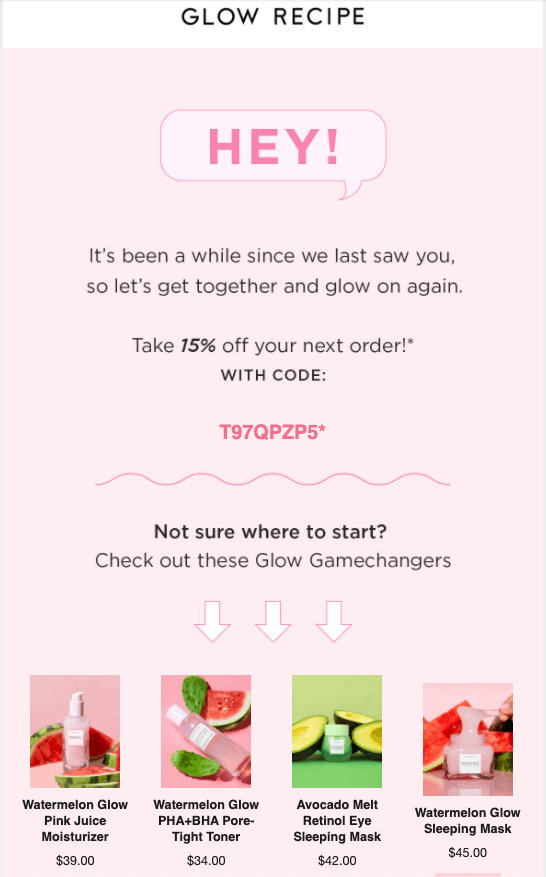
Here are a few well-designed re-engagement emails to give you some inspiration.
1. Asana’s friendly check-in

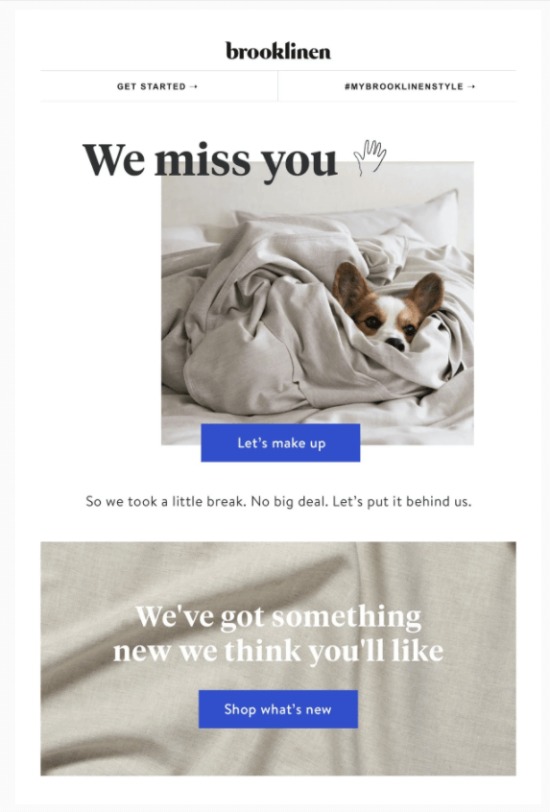
2. Brooklinen’s emotional plea
3. Glow’s tempting offer
Now – it’s over to you. Good luck with your re-engagement campaign!
Stuck for ideas? Let’s chat about your best strategy for re-engaging your audience.

Thank you for reading!
Next week will be the last email marketing blog in my series and we’ll cover promotional emails for new products and services. See you then!
Sources
1 – https://www.betterup.com/blog/how-motivation-works-in-the-brain#:~:text=The%20dopamine%20signal%20moving%20in,the%20top%20of%20our%20brains.
2 – https://www.campaignmonitor.com/resources/knowledge-base/should-you-personalize-your-subject-lines/
 Hayley Hickmott-Maurice | Copywriting Services