
The key word here is ‘strategic’.
This isn’t just another blog with ‘five things you must include in your ad’ or ‘biggest social trends to jump on’ (although I do cover a few of those later on).
No, this is about taking a measured approach to your paid social advertising and not getting swept away by the hype of earning £££ fast or tempted to push the big red Instagram BOOST button!
So let’s dive in.
What does paid social advertising offer?
In my last post on using organic social content to build an authentic brand, we explored how to use a long-game approach to nurture ideal customers and clients.
Non-organic social content, or paid social advertising, wins you quicker gains.
Paid ads are the posts and reels that pop up on your feed with a ‘sponsored’ or ‘promoted’ label. Business owners and social media teams budget money, plan, create and publish these ads to meet business goals.
When I scrolled to find some good examples for this blog, I received an ad every 4 or 5 posts. That’s a lot! This type of paid content is regularly and reliably seen by a vast audience every day and its impact can be huge.
What are the other benefits of paid social ads?
Ads target your audience directly. Not having to rely on an algorithm to be seen takes away a lot of unnecessary stress. And the fact that you specifically target the exact people who need your product/service means conversions (clicks, sales, enquiries) are high. Essentially, it takes a lot of the guesswork out of your marketing.

But, paid advertising is not an easy route to navigate as I’m sure those of you who have produced an ad before will confirm!
You’re investing your hard-earned money back into your advertising so it is only right that you should stop and strategise first.
Here, we’ll work our way through the steps to produce your social media ad with a focus on using the best writing at each stage to maximise impact.
Purpose
Start off by picking one of your business goals for the quarter or year. You need this narrow focus to make sure your social ad has the best return on investment (ROI) for you and your business. After all, you are paying for it.
Please don’t press that Instagram boost button randomly (I know, it really wants you to!). 🤡
Here are a few examples of goals that targeted advertising can help you achieve:
🙋Gain subscribers to your mailing list
👀Get more followers and eyes on your brand
📈Increase sales of a particular product/service
🎯Reach specific, new clients
📆Increase bookings for an upcoming event
It’s worth saying at this stage that if you’re starting advertising for the first time with a small following on social media, you’ll want to prioritise increasing awareness of your brand first. If you do invest in an ad that targets sales before people really know and trust you, this could fall flat unfortunately.
Your chosen ad platform is another thing to consider to avoid shouting into the abyss…
Match purpose to platform
It’s easier to duplicate a social ad across multiple platforms, BUT, if you do this, don’t expect it to have the same effect.
You’re much better off slightly tweaking the advert to match the vibe of where you are posting. You don’t have to start from scratch but repurpose the content with some changes to connect better with different audiences.
For instance:
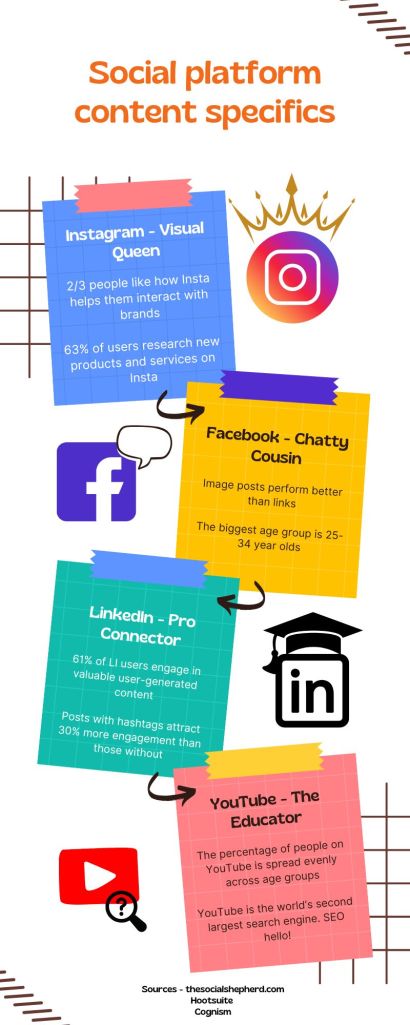
Facebook users mainly engage with their friends and family on the platform. It’s a bit gossipy, fun and home to millennials! E-commerce and B2C brands perform particularly well when advertising here because often (not always) those brands have a more playful and light-hearted tone.
Instagram ads should be highly visual, and immersive and make for eye-catching reading as user scroll on their phones. Make sure your ads are designed for mobile format if posting on this platform. There are also a larger range of formats for Insta ads such as carousels, stories, videos and images.
LinkedIn ads tend to work best if they feature some thought-provoking prompt or they are career-adjacent. This means you may need even more specificity when writing the messaging ads to speak directly to the exact industry you are targeting. They do also have a smaller range of ad formats available.
You may decide just to double down with your ads on one platform that best suits your brand voice.
So, when you’ve figured out your purpose and platform, what’s next?
Plan
The great thing about paid advertisements on socials is that pretty much all of the platforms provide the planning structure for you! And they guide you through it step by step – hooray!
Here’s what you’ll have to make decisions about:
📲Social campaign objective
Your chosen platform will start by giving you options for your campaign objective. Here are some examples:
🟡Awareness
🟠Lead generation
🟡Increase sales
🟠Website traffic
🟡Grow audience
🟠Market insights
This objective links directly to your business goal, so go back to that and align your campaign carefully.
Let’s match some goals with campaign objectives…
| Goal | Campaign objective |
| Gain 100 new subscribers | Grow audience |
| Get more followers and eyes on the brand | Awareness |
| Reach specific, new clients | Lead generation |
| Gain bookings for an upcoming event | Increase sales |
You’ll (hopefully) already have a basic idea of who you want to see your ad since you have chosen a suitable platform. But you’ll want to now dig deeper into your target audience to make your ad resonate and prompt action.
🧐Target audience
The ad tool will give you some suggestions and choices for audience demographics but to help you get a headstart…
Here’s a quick exercise for you: think about what your typical customer/client is like.

If you haven’t created a buyer persona before, you might want to plan this out before choosing your audience as then you can really hone in on the customers you want rather than wasting time saying a polite no to customers who can’t pay you enough or commit.
🎨Ad creation
Three words – Keep. It. Clean.
Designers will tell you over and over that space is so important. Our brains can only take in so much information in a glance and if something looks too busy, we switch off from EVERYTHING in that message.

My advice? Make friends with Canva or a similar content creation tool – I use it to keep my design branding consistent plus it’s a huge time-saver!
Think one message per visual and that will keep your social ad easy-on-the-eye.
Successful ads feature a tempting hook, one visual (an image or video), concise copy and a compelling call to action.
Ad messaging that focuses on one pain point and one clear benefit achieves a higher ROI than a cluttered ad that tries to showcase all and everything the buyer will receive.
Want to get even more analytical? Well, you should!
🧪A/B testing
A/B testing is an invaluable way of getting real feedback on your content. It uses a 50/50 approach. You can set it so that half your audience sees advert A and half advert B.
No, you don’t have to make a whole other advert!
The adverts should be almost identical with just ONE change. Just changing one thing is important because it’s what will help you get the success criteria for a high-performing advert.
Things you could change:
✏️Headline
🖋️CTA
✏️Hook
🖋️Question or no question
Visuals to change include colours, product positioning and use of emojis to name just a few.
After your campaign, may notice that more people clicked on the link in advert A, where you used a question as a hook. Bingo – you have a proven technique for your next ad.
So, you’re ad is out there… but this process isn’t a one-and-done. Like all things content-related, a holistic approach is needed for reliable leads, bookings, sales and growth.
Balancing organic vs paid social content
When planning your content calendar, think carefully about complementing your organic posting with your paid ads.

Paid and organic should work in balance of each other as part of your strategy.
Here’s how that might look.
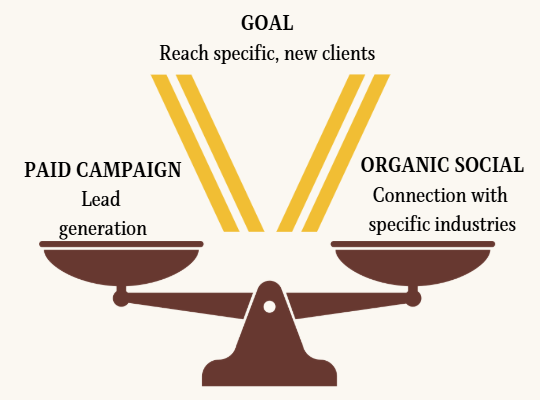
Your organic posts could highlight shared values that connect you to new clients, empathise with the pain points of those clients and show specific benefits of your service.
After engaging with your organic posting and beginning to trust your brand, new clients see your ad prompting them to enquire about your services or book a free consultation and BOOM!
Now, we’ve gone through a lot of the strategy and brain stuff, let’s get onto some practical techniques that you can implement today in your social media ad.
Paid social best practices in 2025
💁♂️User-generated content in your ads is performing even better than testimonials now.
This content shows authentic snapshots (video or photos) of real people sharing their story about your product or service.
It works on so many levels to create trust. It’s real and people relate to it. It also meets a human psychological need to be accepted by peers and ‘do what others are doing’.
📹Short form videos are still the fastest-growing media format and there’s no surprises there. They give us that instant dopamine hit but make sure you couple them with great copy so that the viewer knows what to do once they’ve watched the video!
💥Many creators are moving their CTA earlier in their videos, now, to keep up with shorter attention spans and to make sure their message isn’t lost. Catch more conversions by putting a short CTA at the start and a slightly more detailed one at the end of your video.
🎮Ads are becoming increasingly interactive and – it’s fun! Games and quizzes really do work. Think how you’d feel about a quiz to discover your perfect trainers or a few questions that give you a tiredness level. Some brands feature 3D views of products or challenges for customers to get discounts. It’s making me want to play (and win) just thinking about it!
Now, something to avoid with paid social ads.
Don’t get spammy.
Paid advertising is pretty close to hard selling with it’s more direct tone, bold offer and strong CTA. This can be annoying for users who just want to scroll for fun.
So, it’s best to set a frequency limit on how often social media users will see your add. Say, 5 times. Let’s be honest, if they haven’t gone for it by then, they’re unlikely to.
More top tips for social media advertising
🦻Always assume your audience is listening to videos with the sound off. Always use subtitles.
📘If you choose a carousel post ad, include an element of storytelling and personal experience to keep readers swiping.
🙌Don’t bury the lede. Make sure the most important aspect is front and centre, whether that’s your product, an offer or a new service.
Like a lot of you, I love a good visual example. Here are some good ad examples that I came across this week.
Paid social advertising examples
1. NSPCC
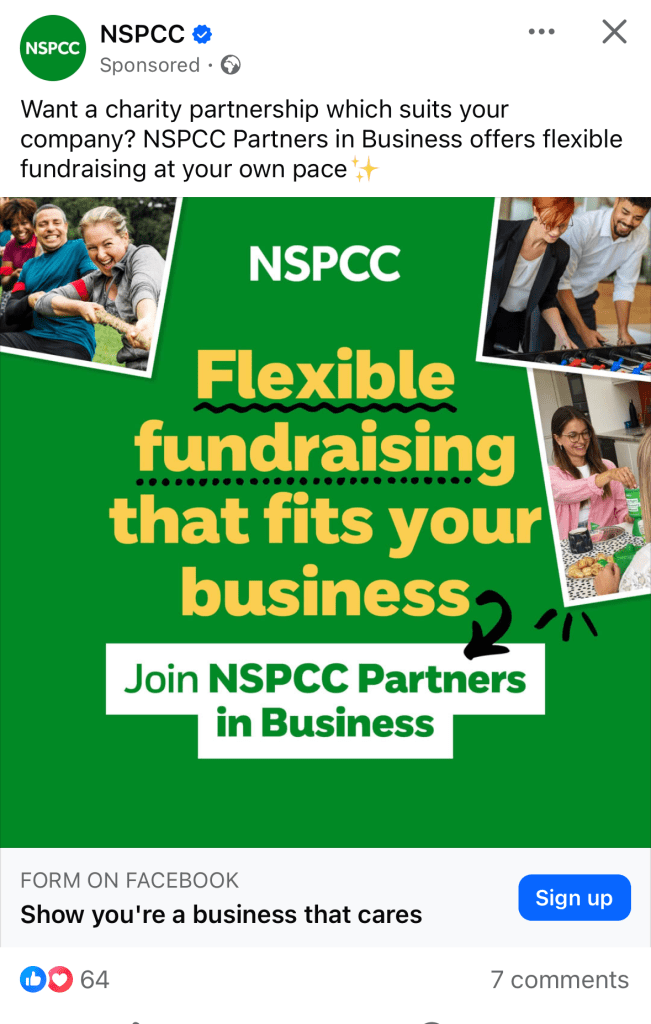
This is a hand-clap moment. So targeted – me a business owner with a big passion for education and safeguarding children. Then that CTA – show you’re a business that cares – hits right in the heart, doesn’t it?
2. John Lewis

A cute video of friends setting up for a Galentines night – it gave me insane FOMO! Did I purchase the plates it’s advertising? No, but I will have John Lewis in mind for crockery next time I need a set.
3. The Cornish Company
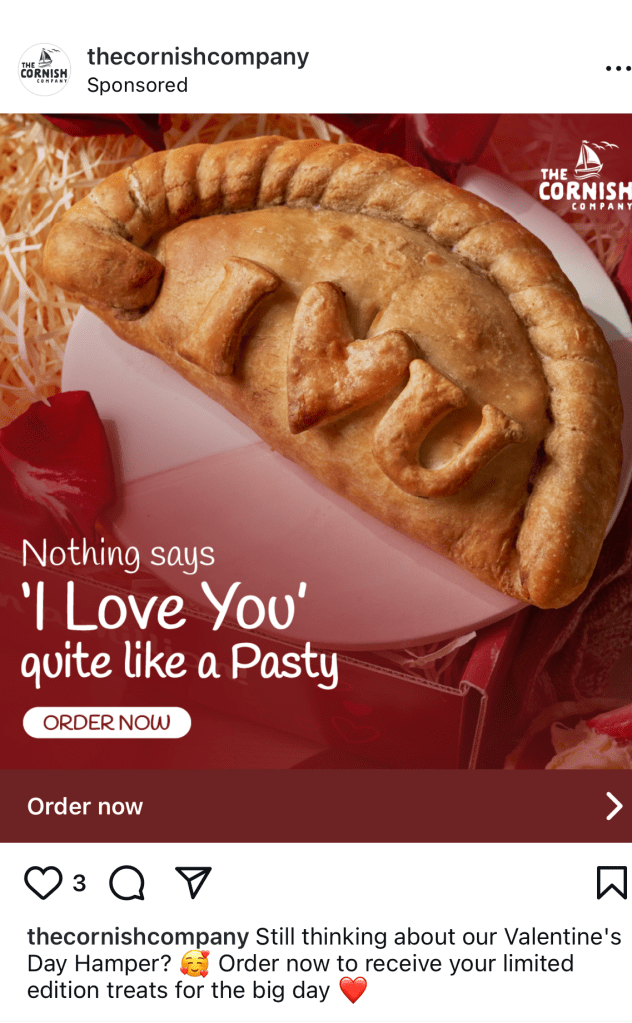
I’ve got to credit the imagery here – just mmmmm. Making the pasty the main feature was a great choice. The copy is seasonal and simple – appealing to the down-to-earth nature of a pasty over a more lavish bouquet of roses or champagne. Again, nicely targeted at my values and making it very easy to click on that order now link…
After all this creating, we’re ready to kick back and have a rest. But you’ll need to geek out a bit more to keep momentum going!
Business never stops… it’s time to check your metrics.
Analysing the performance of your social media ads
All platforms will give you some feedback on how well your ad is performing. They might outline audience, impressions (times your ad was displayed on any screen) and engagement (interaction with your ad).
Some, like LinkedIn go further to break down specifics like the number of clicks to your landing page.
As a minimum, make a note of the areas of success in your advertising. This will build a picture over time of what works for your ideal customers and what you should repeat.

Thank you for reading! I wish you luck and high ROI in your paid social ad creation!
I’d love to hear how this post helped you with your approach.
Leave your thoughts in the comments!
If the thought of creating your paid ad leaves you queasy, I would love to write it for you. I kind of know what I’m doing…😉 Book a free consultation with me to chat about what you want to advertise!
Sources
1- https://www.semrush.com/blog/paid-social/
 Hayley Hickmott-Maurice | Copywriting Services
Leave a comment